

Harshitha Govindaraju

PhD candidate · ECE · Rutgers

HarshithaGovindaraju

I build both ends of a biomedical instrument — the low-noise sensor that captures the signal, and the deep-learning model that reads it out.

SNR ↗ RECOVERED
Published
The Analyst · RSC
Prior
Siemens Healthineers · 2 yrs
Live tools
06 deployed
Program
Rutgers ECE · PhD

Take a low-SNR measurement no one trusts yet, and turn it into a number a clinician can act on.

01/ What I build

The whole chain — sensor to readout

Machine-learning people rarely touch the hardware; sensor people rarely train a model. I work both ends. I build fluorescence and Hall-effect biosensors — the low-noise analog front-end, the COMSOL device physics, the microfluidics — then the deep-learning readout that pulls a signal out of the noise floor and turns it into a number a clinician can act on. Before Rutgers: two years in SPECT R&D at Siemens Healthineers.

I work across the full chain — low-noise analog front ends, COMSOL multiphysics models of the sensor, and the deep-learning code that reads it out — because in point-of-care diagnostics the hardware and the algorithm only work when they are designed together. Most of what I build ends up as an open, no-install web tool so collaborators and clinicians can run it without setup.

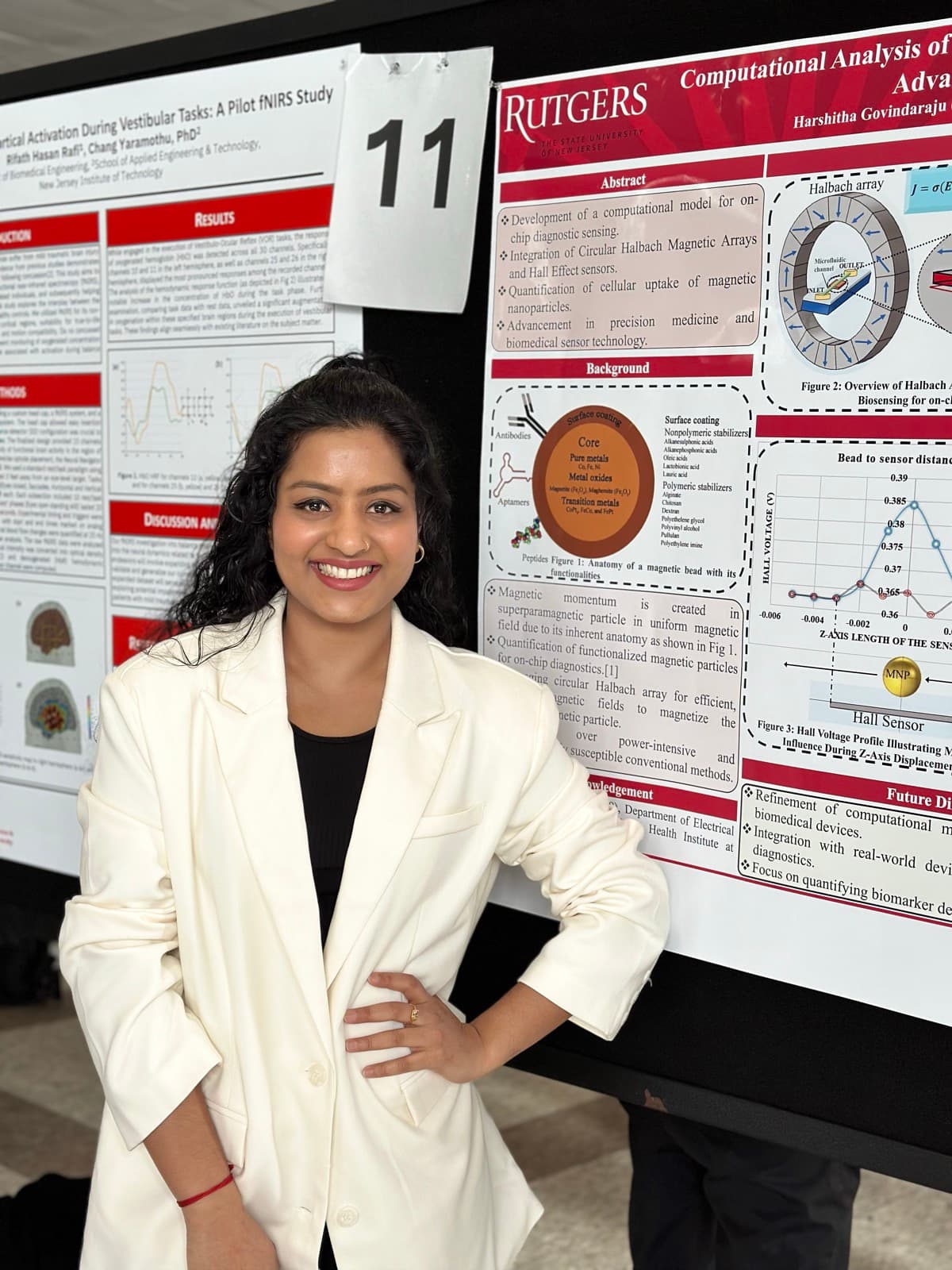
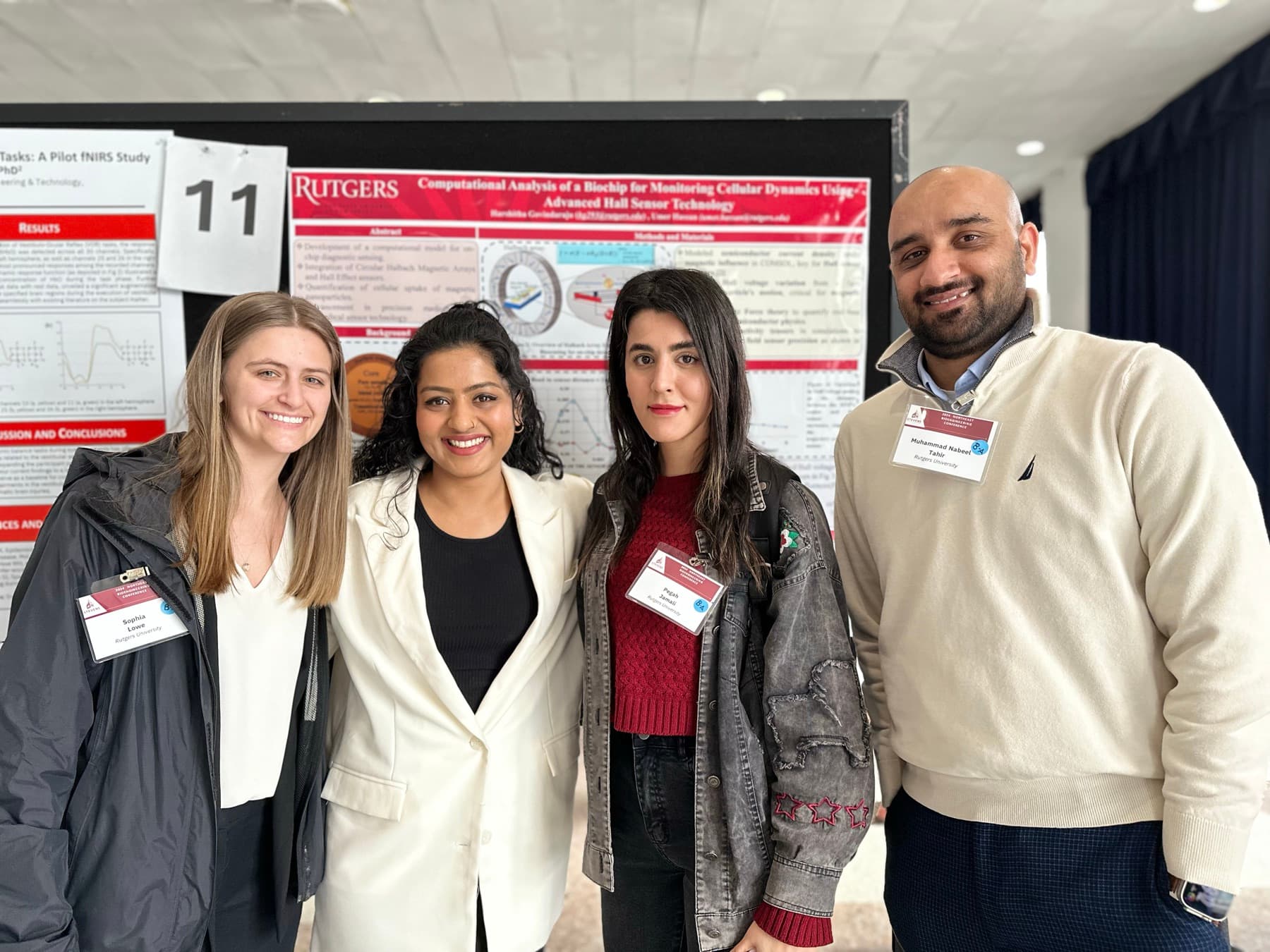
Harshitha Govindaraju presenting a research poster on Halbach-array Hall-effect biosensing at a Rutgers / IEEE session.
Halbach-array Hall biosensor · Rutgers
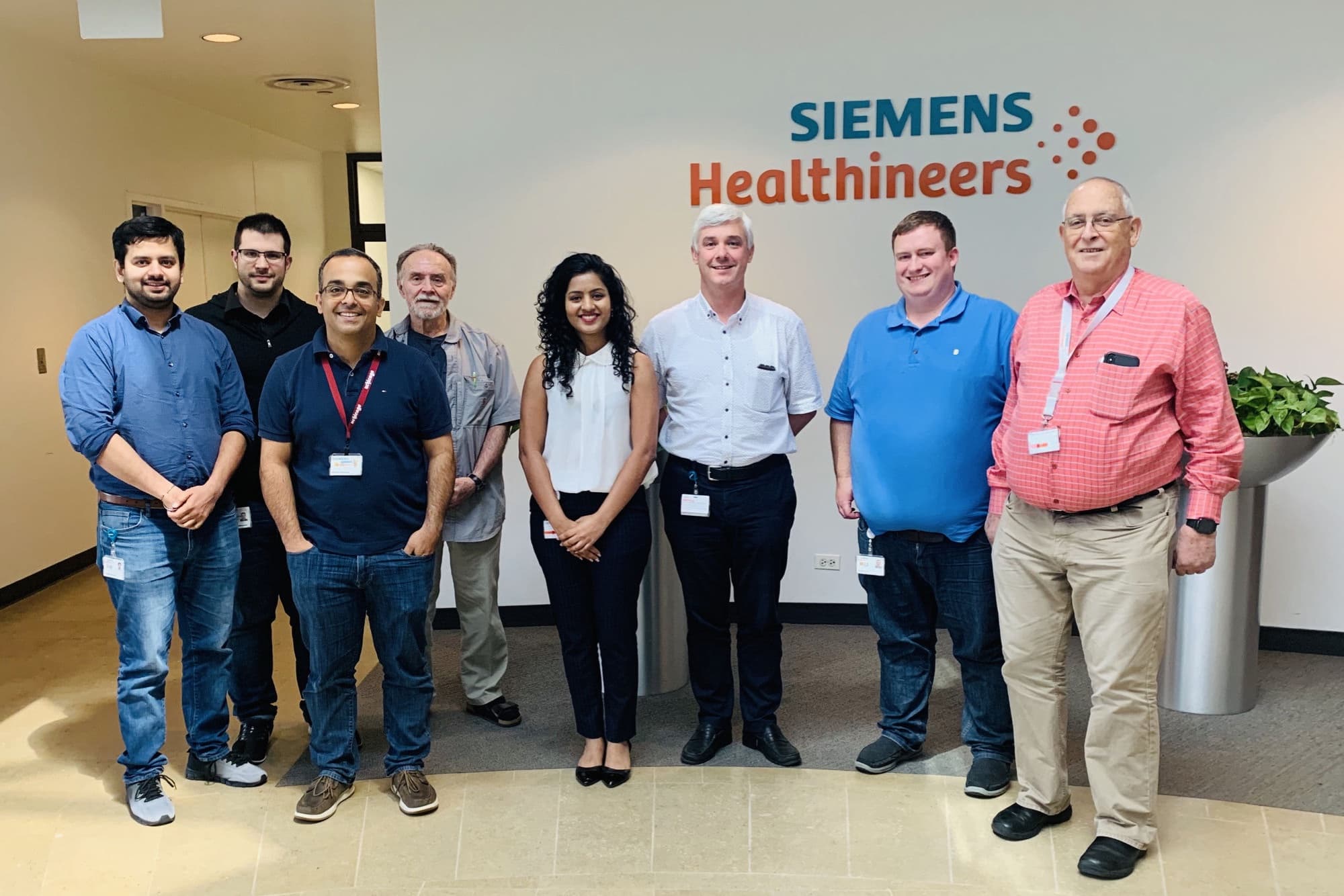
Harshitha with the SPECT R&D team at Siemens Healthineers, in front of the branded wall.
SPECT R&D team · Siemens Healthineers
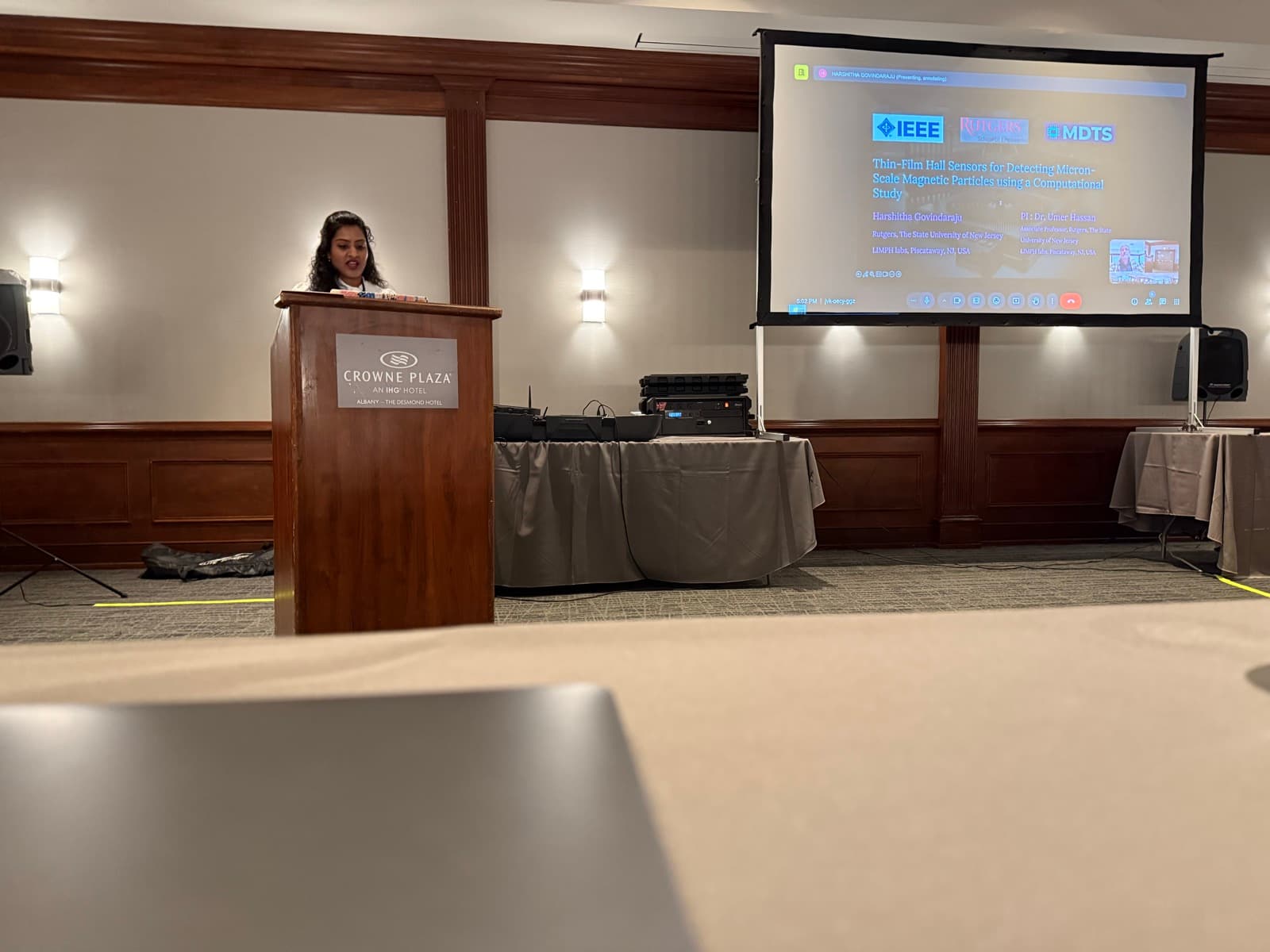
Harshitha presenting 'Thin-Film Hall Sensors for Detecting Micron-Scale Magnetic Particles' at an IEEE MDTS conference session.
Conference talk · IEEE MDTS
Harshitha at the Siemens Healthineers SPECT R&D site, where she built GPU-scale imaging pipelines.
SPECT R&D · Siemens Healthineers
02/ Live tools

Everything here actually runs

Each of these is deployed and interactive — open one and change a parameter. Each of the four also has an on-site deep-dive explainer.

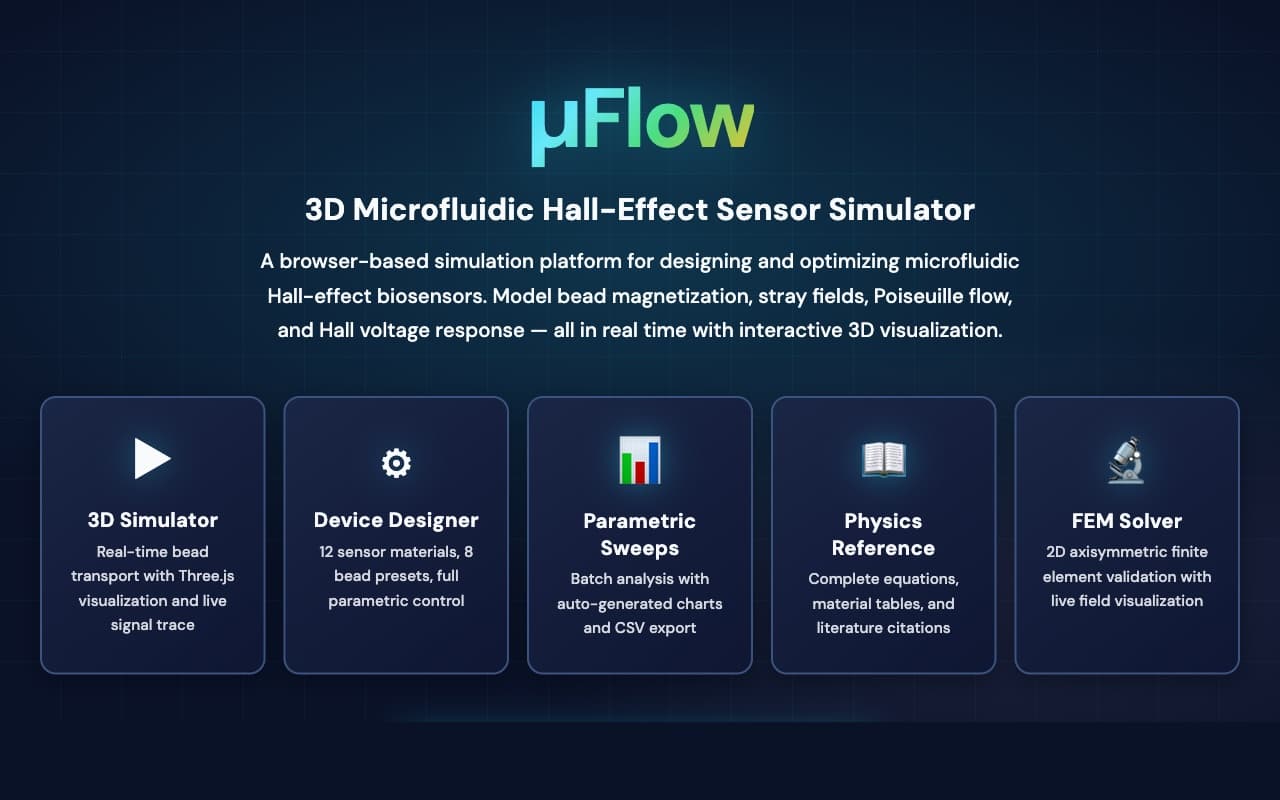
uFlow 3D simulator showing beads traversing a microfluidic channel with a live Hall-voltage trace.

FIG. 1

uFlow — Microfluidic Hall Simulator

3D Three.js simulator with live signal trace

A real-time 3D microfluidic channel where magnetic beads flow past a Hall sensor under a Halbach array, with the Hall-voltage waveform updating live. Validated against COMSOL to under 6% error.

Three.jsWebGLSoftwareX
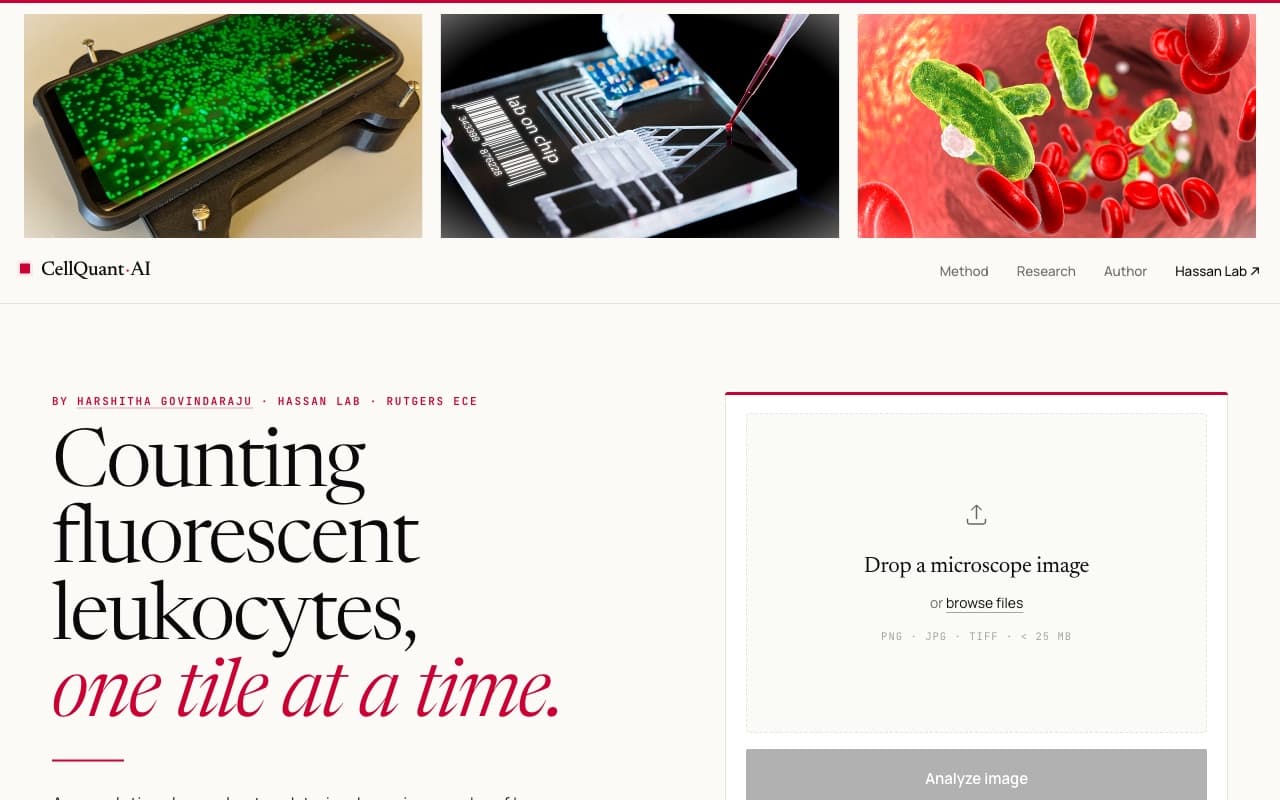
CellQuant AI web app counting leukocytes in an uploaded fluorescence micrograph.

FIG. 2

CellQuant AI

CNN-based cell quantification

Counts leukocytes in fluorescent micrographs from a browser upload — a 12-layer CNN scores image tiles and sums them. From the IEEE Access leukocyte-quantification work.

TensorFlowFastAPI7.9M params
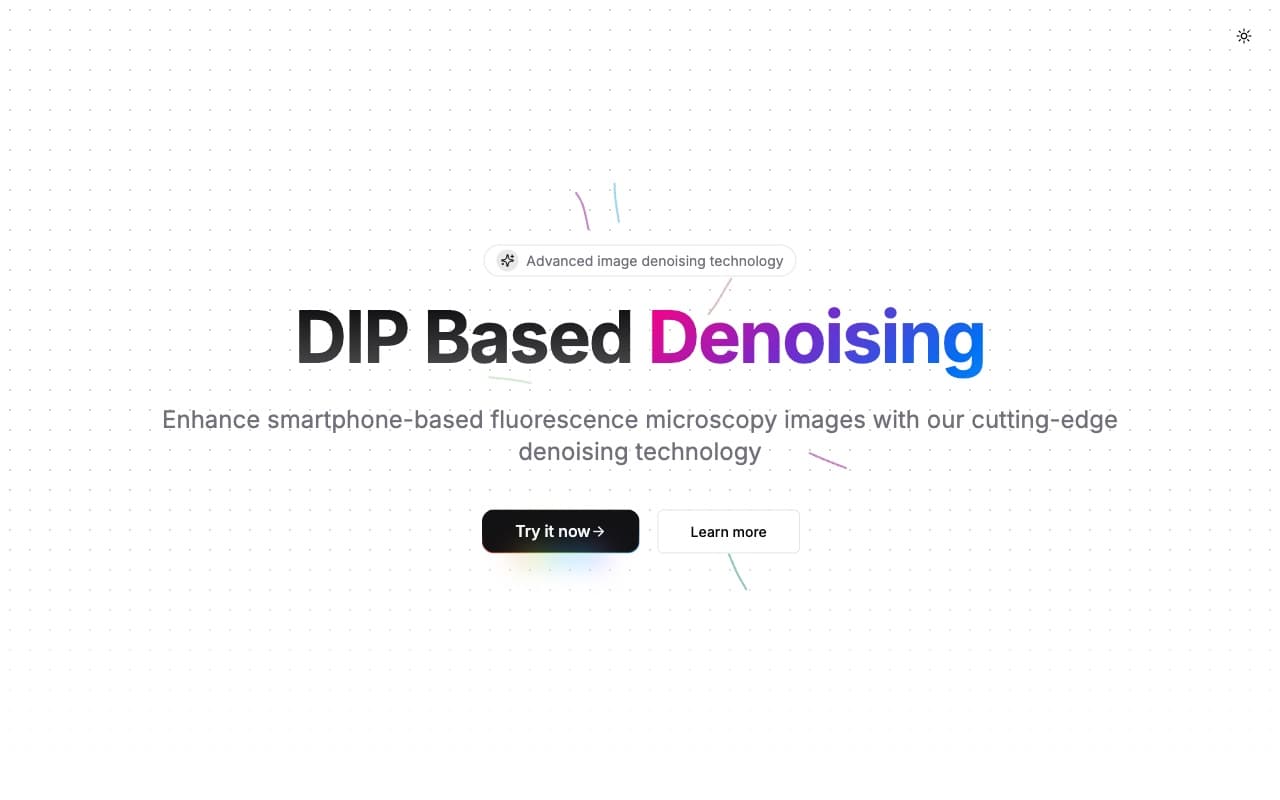
HIST-DIP web app showing a noisy fluorescence input recovered into a sharp output.

FIG. 3

HIST-DIP

Self-supervised fluorescence image recovery

Recovers low-SNR smartphone-microscope images with no paired training data, pairing histogram thresholding with a Deep Image Prior. Published in The Analyst (RSC).

Deep Image PriorThe Analyst 2025
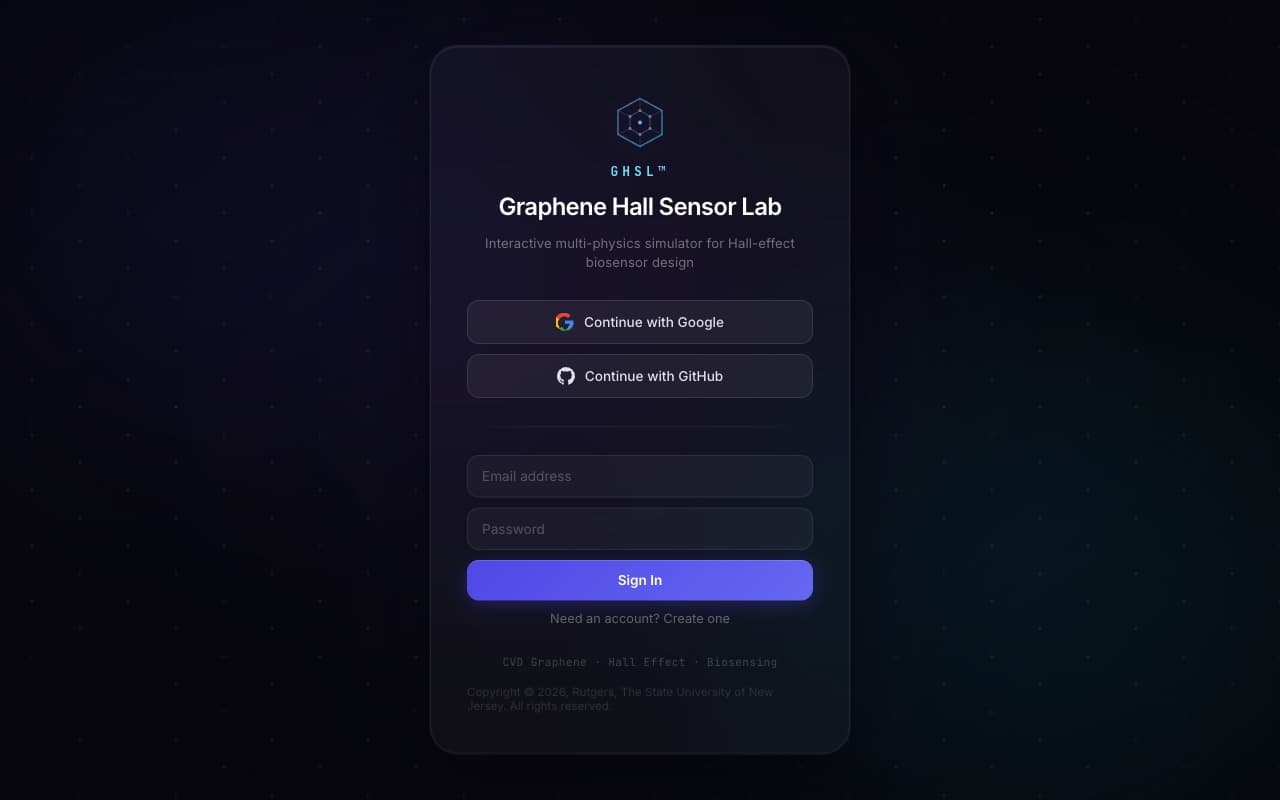
GHSL simulator showing signal, noise and SNR heatmaps for a graphene Hall sensor.

FIG. 4

GHSL — Graphene Hall Sensor Lab

Interactive multiphysics simulator

Simulates superparamagnetic-microbead detection on a back-gated CVD graphene Hall sensor — Langevin magnetization, dipole stray fields, and gate-tunable carrier density, all recomputed live.

ReactCanvas9 governing equations

Also built

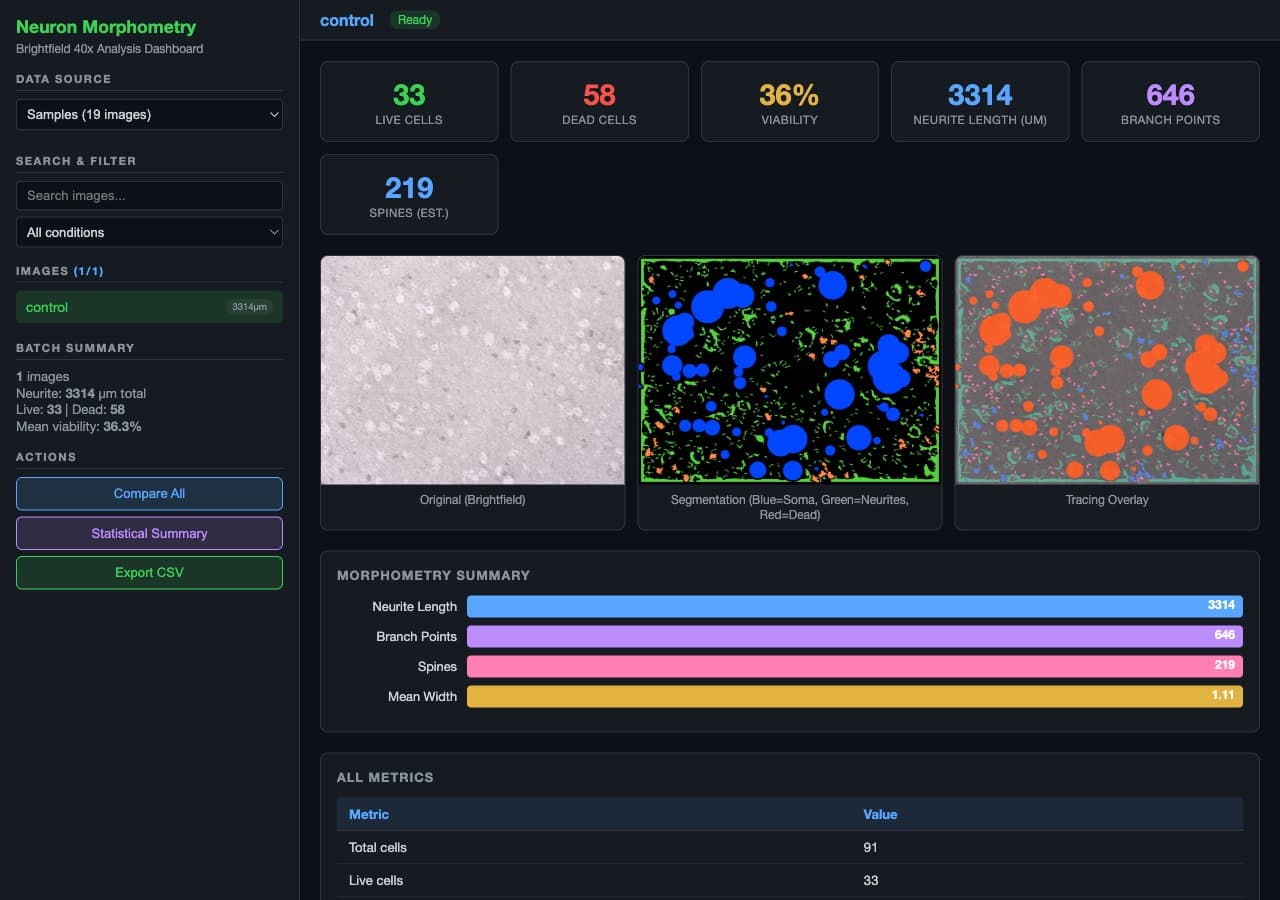
Neuron morphometry dashboard: live/dead cell counts, viability, neurite length, and a brightfield / segmentation / tracing overlay.

FIG. 5

Neuron Morphometry Dashboard

Automated neuron-health image analysis

Quantifies neuron viability, neurite length, and branching from brightfield microscopy using Frangi vesselness filtering, in an interactive dashboard for antioxidant-treatment screening.

OpenCVscikit-imageFrangi
GFET biosensor measurement setup for C-reactive protein detection.

FIG. 6

GFET Biosensor — CRP Detection

Graphene FET lab instrument

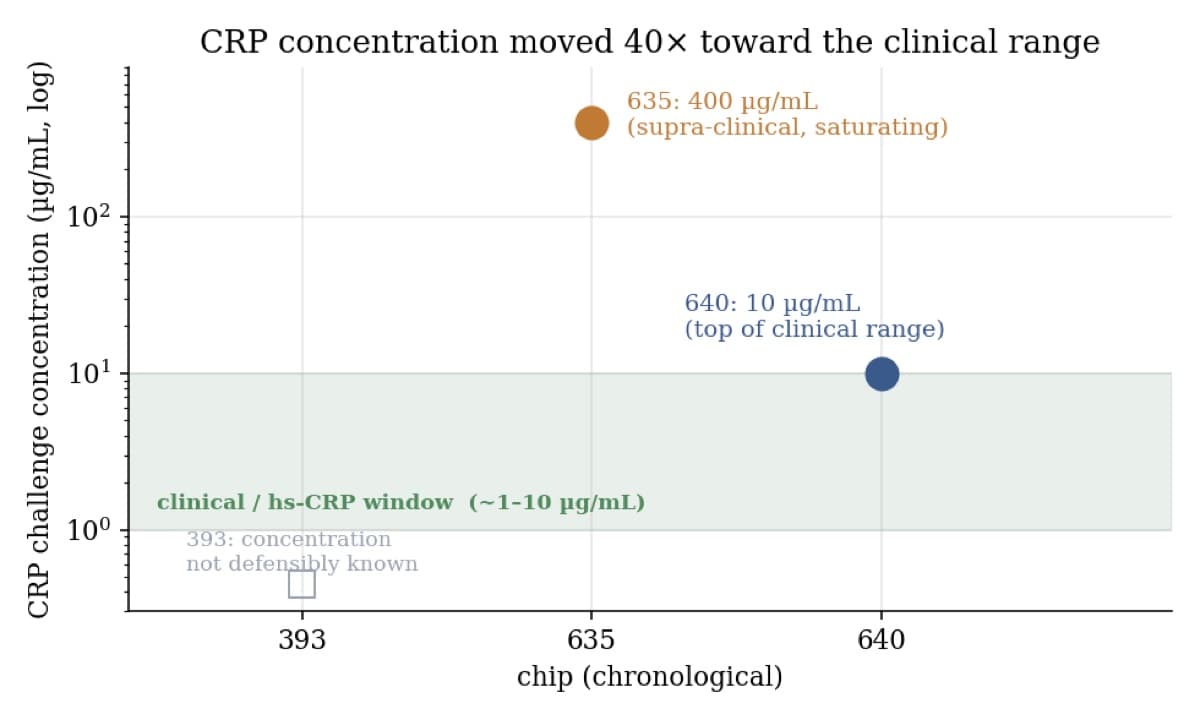
A label-free graphene field-effect biosensor for C-reactive protein: a 28-channel Graphenea mGFET with NI-DAQ readout and reference-subtracted resistance shifts (R² ≈ 0.99999).

PythonNI-DAQmxGraphene FET
03/ Publications

A few papers that matter

[2]

Machine-Learning–Enabled Leukocyte Quantification Using a Smartphone-Coupled 3D-Printed Microfluidic Biosensor

IEEE Access (2022)

The end-to-end case that a $12 smartphone microscope plus a CNN can count white blood cells accurately enough to be clinically meaningful.

[3]

Modeling Enhanced Detection Dynamics of Magnetic Particles with Halbach Array and Hall-Effect Sensing for Biomedical Applications

Multiphysics design study

The physics behind uFlow and GHSL: how a Halbach array and Hall sensor geometry can be co-optimized in simulation before anything is fabricated.

[4]

Particle Quantification from a Smartphone-Based Biosensor Using Deep Convolutional Neural Networks for Clinical Diagnosis

Peer-reviewed

Generalizes the counting approach beyond leukocytes to fluorescent particles, tying imaging-derived features to a clinical readout.

[5]

DICOM Data Storage and Retrieval with MongoDB

Peer-reviewed

The infrastructure side of the work at Siemens Healthineers — turning raw, semi-structured detector scans into a queryable, integrity-checked research dataset.

In progress — Graphene Hall-Effect Biosensor for Multiplexed Biomarker Detection — under review, IEEE Sensors Journal.

Full publication list on Google Scholar

04/ Contact

No forms, no bots. Just email.

The fastest way to reach me is email — I read everything.

Based in New Brunswick, NJ · Open to on-site NYC, hybrid, or remote for the right team